Checkered Varsity Mama
A Designer’s First Glance: Bold, Playful, and Instantly Recognizable
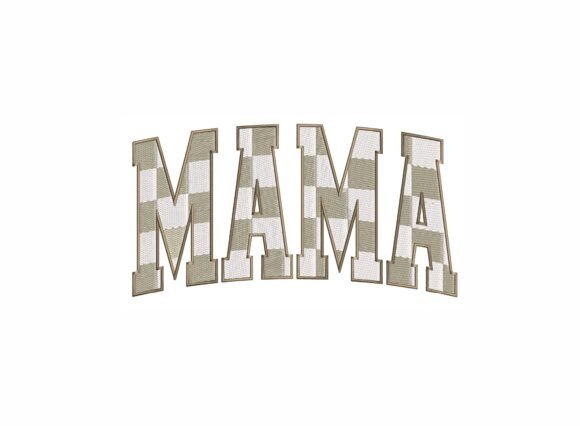
When Checkered Varsity Mama opens in my embroidery software, the first thing that hits me is its confident silhouette—clean lines, balanced negative space, and that unmistakable varsity rhythm. It’s not fussy or overly cutesy; it leans into sporty charm with a grounded, warm energy. The checkered motif isn’t just decorative—it’s structural, giving the lettering and shape visual weight without crowding. As a designer who regularly selects embroidery files for client work and small-batch production, I immediately see where this lands: on relaxed-fit sweatshirts, sturdy canvas totes, and cotton aprons meant to be worn, not tucked away. It feels like a design made for real life—not just digital previews.
How It Stitches Up: Real-World Performance on Common Projects
I tested Checkered Varsity Mama across three everyday substrates: midweight cotton twill (for tote bags), 100% combed ring-spun jersey (for soft unisex tees), and fleece-backed French terry (for cozy baby hoodies). On all three, the stitch density held up cleanly—no thread nesting, no skipped stitches—when paired with medium-weight cutaway stabilizer. The satin-stitched outlines stayed crisp, and the fill stitches in the checkered blocks didn’t puff or shadow, even at the smallest recommended size.
This isn’t an appliqué design, so there’s no fabric layering or trimming involved—just pure machine embroidery. That makes it faster to run at scale, ideal for Etsy sellers prepping Mother’s Day bundles or craft fair vendors stitching custom sweatshirt orders. I especially liked how it read on a charcoal gray crewneck: the contrast was strong but not harsh, and the design retained its personality without shouting. On lighter fabrics, switching to ecru or oatmeal thread added subtle sophistication—proof that Checkered Varsity Mama adapts well to thoughtful color storytelling.
Where It Shines—and Where to Pause
- Tote bag design: Perfect center-chest placement on wide-bottomed canvas bags. The horizontal spread gives it presence without distortion.
- Sweatshirt embroidery: Holds beautifully on ribbed cuffs and curved hems when hooped correctly—just avoid stitching directly over seam allowances.
- Baby embroidery: Works best on onesies sized 6–12 months and above; smaller sizes risk overcrowding the chest area unless you use the smallest of the seven sizes.
- Embroidered patch: Not intended as a standalone patch file—but it stitches cleanly onto twill or denim patches if backed properly.
- Caps & curved surfaces: Proceed with caution. The shape has width, and tight curves can stretch satin-stitch edges. Test on scrap first—or reserve it for flat panels like front pockets or back yokes.
Fabric & Finish Considerations You Can’t Skip
Thin or highly stretchy fabrics—like lightweight knits or slubbed linen—need extra stabilization under Checkered Varsity Mama. Its clean geometry depends on stable fabric movement, and without it, the checkered blocks can blur or skew. Dark fabrics? Absolutely fine—but inspect your top thread tension closely. A single loose stitch in the white-on-black version will stand out. And while it’s durable enough for frequent washing, I’d avoid high-heat drying on delicate items like embroidered tea towels or nursery pillow covers—the dense fill areas hold heat longer than open-stitch motifs.
Design Assets That Build Trust
What makes Checkered Varsity Mama more than just another “mom life” embroidery file is how consistently it reads as handmade *and* professional. Customers don’t just buy the word “Mama”—they buy the feeling of intention behind it. This design delivers that: balanced spacing, intentional line weight, and a layout that doesn’t compete with garment texture. When used on boutique merchandise—say, a limited-run apron collection or personalized holiday gift set—it signals care, not cliché. That builds trust faster than any product description ever could.
Practical Designer Notes Before You Stitch
- Always run a test stitch on scrap fabric matching your final substrate—and do it with your actual thread colors, not just default settings.
- Review stitch density in your editing software. If the checkered blocks look overly heavy, consider reducing fill density by 5–10% for lightweight garments.
- Confirm hoop size compatibility. With seven sizes included, verify which fits your standard hoops before digitizing for production runs.
- Inspect corners and transitions. The “V” and “A” in “Varsity” have tight angles—make sure they’re sharp, not rounded, in your preview.
- Test black-and-white mockups. Does the design retain clarity in grayscale? That matters for printed catalogs, social thumbnails, and Etsy listing visuals.
- Compare light vs. dark background renders. Some thread colors vanish on certain fabrics—especially metallic or heathered tones.
- Use appropriate stabilizer: cutaway for knits, tear-away for stable wovens, and fusible + cutaway for layered or textured items like quilting cotton tea towels.
- Double-check licensing terms before selling finished products or bundling the digital embroidery file. Commercial use isn’t automatic—even with “7 sizes.”
Mother’s Day Isn’t Just a Date—It’s a Design Moment
Checkered Varsity Mama arrives at the right time—not because it says “Mom,” but because it says something more specific: capable, grounded, quietly proud. It’s the kind of embroidery file that elevates a $24 tote into a keepsake, or turns a plain sweatshirt into a family heirloom-in-the-making. For Etsy sellers building seasonal collections, for small shop owners curating local gift boxes, and for designers sourcing reliable embroidery assets—this one earns repeat use. It doesn’t try to be everything. It does one thing very well: celebrate motherhood with style, substance, and stitch-perfect reliability.