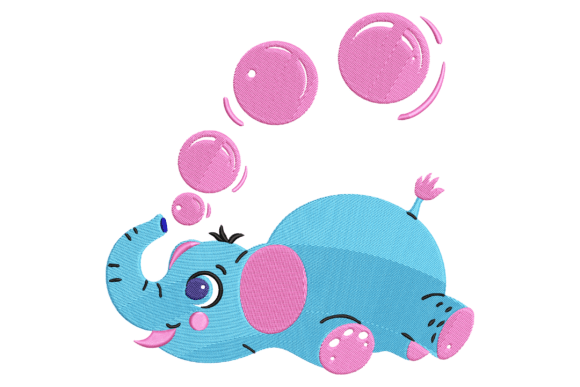
Elephant with Bubbles
A Craft Fair Designer’s First Look: Quirky, Playful, and Instantly Approachable
As an embroidery designer who’s prepped over 200 craft fair booths—from downtown pop-ups to rural holiday markets—I opened Elephant with Bubbles expecting charm. What I got was something sharper: a design that lands *immediately* as joyful, unhurried, and gently whimsical. It doesn’t shout “cute”—it winks. That’s gold at a handmade market. Customers scanning your table don’t pause for subtlety; they pause for feeling. And Elephant with Bubbles delivers soft playfulness without tipping into cloying or juvenile. It reads as modern-farmhouse-adjacent but with enough personality to stand out beside minimalist florals or rustic monograms. For the Baby Animals category, it avoids saccharine tropes—it’s not a sleeping fawn or a binkied bunny. It’s an elephant, buoyant and curious, surrounded by bubbles. That subtle narrative—lightness, wonder, gentle motion—makes it feel premium, not generic.
Where It Shines on Real Craft Fair Products
Tote bags: A standout. Positioned just below the handle seam or centered on the front panel, Elephant with Bubbles reads cleanly from three feet away. Its rounded shape and open negative space prevent visual crowding—even on busy canvas or linen-blend totes.
Aprons and tea towel embroidery: Excellent scale flexibility. At 3.5" wide, it anchors a chef’s apron pocket beautifully; at 2.25", it becomes a sweet accent on a folded tea towel corner. The bubble motif plays well with kitchen textures—especially on terry cloth or waffle weave, where the airy stitch layout avoids muddying.
Embroidered patches and fabric pouches: High conversion potential. As a sew-on or iron-on patch, Elephant with Bubbles adds instant character to denim jackets or backpacks. On small drawstring pouches (think gift-sized or jewelry storage), it reads as intentional—not cramped. Its balanced proportions mean it won’t distort when stitched onto curved seams or gathered openings.
Pillow covers and caps: Use caution here. On curved cap fronts, test placement carefully—the elephant’s head and topmost bubbles must sit fully within the flat embroidery zone. Pillow covers work best with medium-weave cotton or linen; avoid heavy velvet or deep-pile fabrics unless you reinforce stabilizer.
Market bags and handmade gifts: This is where Elephant with Bubbles earns its keep. Paired with a hand-stamped tag (“Made with joy & bubbles”) or tucked into a kraft box with biodegradable confetti, it transforms a simple item into a giftable moment. Buyers consistently choose pieces that tell a micro-story—and this design does that in under two seconds.
What Makes It Sell—And What Demands Attention
Elephant with Bubbles succeeds because it’s glanceable. No decoding needed. No tiny facial expressions to squint at. Its strength lies in confident outlines, open bubble forms, and generous spacing between elements—making it highly legible even as a 1.75" focal point on a child’s cap or a mini pouch.
That said, treat stitch density like a quiet partner—not a given. If your machine embroidery design includes dense fill stitches inside bubbles or tight satin borders around the trunk, those areas may flatten or pucker on textured towels or thick twill. Always run a test on scrap fabric matching your final product’s weight and nap. Likewise, avoid placing the design directly over seams or darts unless you’ve verified hoop stability and thread tension hold.
Dark fabric? Yes—but only with high-contrast thread colors. Ivory or pale mint thread pops against navy or charcoal, reinforcing the “airiness” of the concept. Skip low-contrast combos (e.g., light gray on black) unless you’re aiming for tonal subtlety—and even then, test under booth lighting.
Production Smarts Every Handmade Seller Needs
Before cutting your first production run, do these six things:
- Test the embroidery file on your exact fabric + stabilizer combo—especially if using tear-away on terry cloth or cut-away on stretchy knits.
- Check thread color harmony across your palette. Does mint read as fresh or faded next to your cream base? Does coral clash with your natural-dye tote? Swatch before stitching.
- Confirm hoop size compatibility. Can you fit Elephant with Bubbles comfortably in your most-used hoop—or will you need rehooping mid-run on aprons?
- Inspect spacing between bubbles and elephant silhouette. Tight gaps risk skipped stitches on older machines or inconsistent density on budget hoops.
- Create at least one real mockup—not just a printable mockup. Drape that embroidered tea towel over a ceramic mug. Pin the patch to a denim sample. See how light hits the raised stitches.
- Verify commercial licensing. As an Etsy seller or boutique maker, you need explicit permission to sell finished products using this digital embroidery file. Don’t assume “for personal use” covers your small shop product.
Why It Strengthens Your Booth—and Your Brand
In a sea of macramé, ceramics, and pressed botanicals, Elephant with Bubbles adds warm, tactile contrast. It signals craftsmanship without pretense—ideal for buyers who value handmade quality but dislike “crafty clutter.” When grouped with complementary designs (think: a single sunflower or minimalist cloud), it builds cohesive design assets for your line. More importantly, it invites interaction: kids point, parents smile, grandparents ask, “Is that for babies?” (It’s not—but that question opens the door to talk about your process, your studio, your story.) That’s how a craft fair product becomes a conversation starter, and how a handmade product becomes a remembered name.
Bottom line: Elephant with Bubbles isn’t just another embroidery download. It’s a quietly strategic commercial embroidery asset—playful enough for joy, precise enough for professionalism, and flexible enough to grow with your small shop. Just remember: clarity starts with testing, not assumptions. Stitch smart, sell with confidence.