Water Splash Ocean Whale
A Graceful Leap—Not Just Another Marine Mammals Design
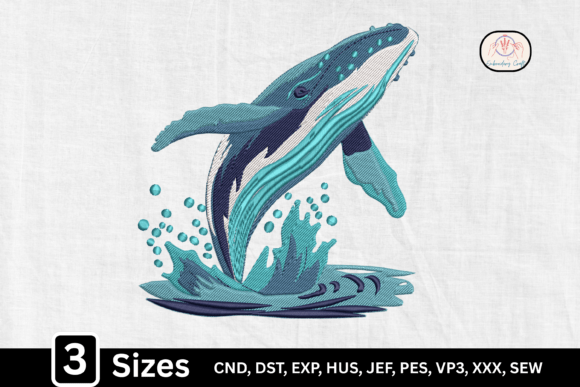
When I first opened the Water Splash Ocean Whale embroidery file, I didn’t just see stitches—I saw movement. That whale isn’t static; it’s mid-leap, tail arcing, water cascading in soft curves around its body. The composition leans into fluidity: no rigid symmetry, no forced centering—just organic rhythm. It feels like a breath of salt air, not a clip-art placeholder. As a designer who’s stitched hundreds of marine-themed pieces for boutique clients and Etsy sellers, I immediately knew this wasn’t just decoration—it was *storytelling* with thread.
Where It Shines (and Where It Asks for Care)
I tested Water Splash Ocean Whale on a natural linen tote bag—my go-to for small shop merchandise—and the result landed beautifully. The curve of the whale’s back aligned with the bag’s shoulder strap seam, making the design feel intentional, not slapped on. On cotton sweatshirts? Equally strong. The stitch density gives enough body to hold up against brushing and wear, but doesn’t overwhelm the fabric’s drape. For baby embroidery—think onesies or muslin swaddle blankets—the gentle blue tones read softly, never garish, and the lack of tiny facial features means no risk of scratchy detail against delicate skin.
But here’s where judgment matters: Water Splash Ocean Whale isn’t built for micro-hoops or ultra-fine details. That splash isn’t made of running stitch outlines—it’s layered fill and satin stitch transitions. On a curved cap front? You’ll need careful digitizing adjustments or a repositioned placement (think side-embroidery on a dad hat brim instead of center-front). And on dark fabric? Don’t assume the default blue thread will pop—test contrast first. A charcoal grey sweatshirt needs either a slightly brighter aqua or a white underlay stitch to keep the ocean feel luminous, not muddy.
Real Project Pulse Check: The Nursery Pillow Cover Test
Last week, I used Water Splash Ocean Whale for a custom pillow cover destined for a coastal-themed nursery. Cotton sateen, medium-weight tear-away stabilizer, standard 70/10 needle. The whale’s outline held crispness through the satin-stitched wave crest, and the fill stitch in the water area had just enough texture—not too dense to stiffen the pillow, not so light it looked washed out. Parents loved it. More importantly, they *recognized* it—not as “a whale,” but as “that joyful leap.” That kind of emotional resonance is rare in machine embroidery designs. It elevates a handmade product from craft to keepsake.
What This Means for Your Craft Business
- Customer trust rises when a design feels considered—not generic. Water Splash Ocean Whale reads as curated, not mass-downloaded.
- Giftability increases because it avoids cliché. No cartoon eyes, no excessive glitter thread suggestions—just elegant marine life energy.
- Brand consistency holds across product lines: use it on tea towels, then match it with a simple whale-outline monogram on matching oven mitts.
- Etsy listings gain quiet professionalism. Buyers scroll past busy, over-digitized designs—but pause for balance, flow, and restraint. This one earns that pause.
Where Caution Is Built In—Not Added Later
This isn’t a “stitch-and-forget” file. The water splash contains subtle overlapping layers—some areas rely on underlay to lift the top fill. On thin or stretchy fabric (like lightweight jersey for kids’ tees), skip the standard cut-away and go for a lightweight fusible + tear-away combo. And if you’re planning holiday embroidery—say, on velvet stockings—run a test on scrap first. Dense satin sections can flatten velvet nap unpredictably.
Also: check whether your version includes optional applique elements. The description mentions “stitched in beautiful blue and…”—that trailing “and” hints at possible color variants or alternate wave treatments. If you’re selling digital embroidery files yourself, confirm licensing covers commercial redistribution *before* bundling Water Splash Ocean Whale into a marine-themed pack. Most reputable sellers do—but always verify.
Designer Notes You’ll Actually Use
- Test the Water Splash Ocean Whale embroidery file on scrap fabric *in your actual project fabric*, not just muslin.
- Review stitch density visually—not just numerically. Zoom in on the tail tip and splash edge: are threads laid smoothly, or piling up?
- Confirm hoop size compatibility before prepping your garment. Some versions may be optimized for 5x7”, others for 4x4”—don’t assume.
- Inspect small details in black-and-white mockups. Does the whale’s silhouette read clearly against solid backgrounds?
- Compare thread colors on both light and dark fabric swatches. Blues behave differently on oatmeal vs. navy.
- Use proper stabilizer—not just “any” tear-away. Match weight to your fabric: medium for cotton twill, lightweight for baby knits.
- If using for commercial embroidery (e.g., custom apparel orders), double-check that your client understands care instructions—especially for items meant for frequent washing.
Final Thought: It’s Not Just an Embroidery File—It’s a Mood Anchor
In a sea of generic marine life motifs, Water Splash Ocean Whale stands out by honoring motion, space, and simplicity. It doesn’t shout. It glides. That makes it unusually versatile: equally at home on a minimalist apron for a seaside café, a personalized gift for a marine biologist’s retirement, or a bold sweatshirt for a coastal school fundraiser. It works because it respects the craft—not just the machine. As a designer, I don’t reach for it when I need “whale-shaped.” I reach for it when I need *wonder*, translated into thread.