★★★☆☆3.6(220 reviews)
Whatever Life Throws at You
First Impression: Sass, Simplicity, and Instant Recognition
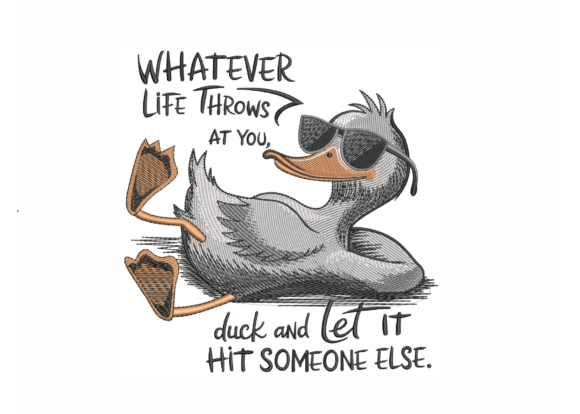
Whatever Life Throws at You lands exactly where it should — bold, cheeky, and effortlessly memorable. As an embroidery designer who’s curated over 200 craft fair booths, I can tell you this isn’t just another animal quote: it’s a mood in duck form. The laid-back duck with shades taps into that universal “I’m fine, but also no” energy — making it instantly relatable for millennials, Gen Z shoppers, and anyone who’s ever survived Monday. It reads as modern, not rustic; playful, not childish; sarcastic, not mean. That balance is rare — and highly saleable.Where It Shines on Craft Fair Products
On a crowded table display, Whatever Life Throws at You stands out strongest when given breathing room and contrast. Here’s how it performs across key handmade categories:- Tote bags: Ideal as a large, centered chest design (8–10" wide). The duck’s silhouette and clean lettering read clearly from 6 feet away — critical for booth traffic flow.
- Aprons: Works beautifully above the pocket or centered on the bib. The relaxed posture of the duck mirrors the apron’s functional ease — feels intentional, not slapped-on.
- Tea towel embroidery: Best placed in the lower corner or along the hem. Avoid dense stitching on terry cloth — test thread tension and stabilizer to prevent puckering.
- Embroidered patches: A natural fit. At 3–4", the duck stays legible, and the phrase wraps cleanly around its shape. Great for sew-on or iron-on versions sold as add-ons.
- Caps and beanies: Use only the duck icon (without text) for curved surfaces — lettering distorts easily on low-profile fronts. Confirm hoop size compatibility before digitizing.
- Fabric pouches & pillow covers: Perfect as a single focal point. The design’s asymmetry (duck leaning, shades tilted) adds visual interest without clutter.
- Market bags & small shop products: Sells especially well alongside matching tea towels and patch sets — customers love building themed bundles.
What Makes It Sell — and What Requires Caution
Whatever Life Throws at You succeeds because it’s emotionally resonant *and* production-practical. The phrase is short enough to avoid tiny lettering, the duck is stylized (not photorealistic), and the “sass” translates through posture — not micro-details. That means lower stitch density, faster hooping, and fewer thread breaks during batch production.- Avoid scaling below 2.5" — the shades and beak lose definition; the sarcasm fades.
- On dark fabric, confirm thread colors provide enough contrast — especially for the duck’s outline and sunglass frames.
- Textured towels and thick canvas require medium-weight cutaway stabilizer — skip tear-away here.
- Dense fill areas (like the duck’s body) may need reduced stitch count if embroidering on lightweight linen — check for stiffness or shadowing.
- Curved cap fronts demand re-digitizing the phrase separately — never stretch the original layout.
Photography, Listings, and Digital Appeal
As a digital embroidery file, Whatever Life Throws at You benefits from clear naming conventions (e.g., “WhateverLifeThrows_4x4”, “_5x7”) and format variety (.pes, .dst, .jef). Buyers scan fast — if your listing doesn’t show scale, fabric examples, and thread color suggestions within 3 seconds, they’ll scroll past.Designer Notes You Can’t Skip
- Test the embroidery file on scrap fabric matching your final product — same weight, same weave, same dye lot.
- Check thread contrast under both daylight and booth lighting — fluorescent lights mute bright threads.
- Review spacing between duck and text — tight kerning risks stitching collisions; too much space weakens the phrase’s punch.
- Confirm hoop size requirements — some versions may need 5x7 or larger for full phrase clarity.
- Inspect stitch density in the duck’s wing and shades — high density = longer run time + potential fabric distortion.
- Use cutaway stabilizer for knits, tear-away for stable cottons, and fusible + cutaway for tea towels.
- Create at least one finished product mockup — not digital, not printed, but stitched, pressed, and photographed in situ.
- Compare how it looks on light vs. dark fabric swatches — adjust underlay or thread hue if needed.
- Verify commercial licensing terms before selling finished products — many digital embroidery file sellers restrict resale of physical goods unless upgraded.
Final Thought: This Duck Isn’t Just Cute — It’s Conversion-Ready
Whatever Life Throws at You isn’t decorative fluff. It’s emotional shorthand — a wink, a sigh, a shared moment of resilience. In a sea of generic florals and overused quotes, it cuts through. It sells because it feels personal, handmade, and unmistakably *true*. For craft fair sellers, Etsy sellers, and boutique makers building a recognizable line of embroidery-based handmade products, this design earns its spot front-and-center — not as filler, but as a signature piece. Just remember: let the duck breathe, respect the fabric, test early, and sell the feeling — not just the stitch.
⬇️ Download Free
Free download · No sign-up required
🔗 You Might Also Like
Animal Quotes
A Seasonal Embroidery Designer’s First Look at This Animal Quotes Staple As an e...
Inspirational
A Seasonal Embroidery Designer’s Real-World Review As an embroidery designer who...

Work
A Thoughtful, Real-World Review for Embroidery Designers As someone who’s digiti...
Birds
A Thoughtful First Impression for Boutique Apparel Designers As an embroidery de...
Baby Animals
A Craft Fair Designer’s First Look: Quirky, Playful, and Instantly Approachable ...
